A Project to Light UP Uptown Butte’s Historic Headframes
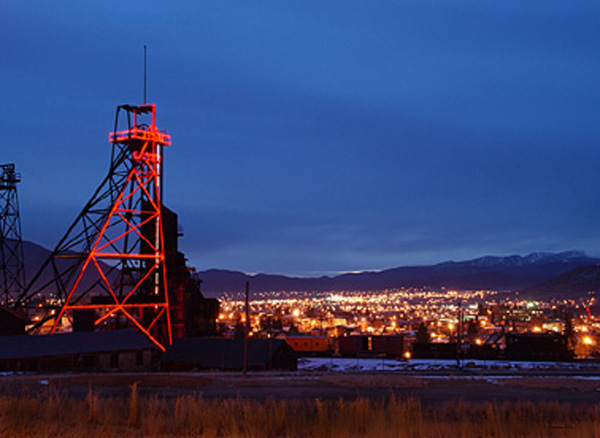
There is no more important symbol of Butte than its headframes that stand over the Hill’s now silent underground copper mine yards. These tall structures–they range from 99 to 200 feet–are remnants of the underground copper mining era that was the engine for the city’s renowned prosperity and the source of its nickname “The Richest Hill on Earth.”
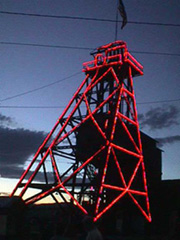
Often mistaken for oil derricks by visitors, they were originally called gallows frames (or gallus frames) because they were used to lower miners to their stations below the surface. The double meaning of the name was not lost on the miners who knew the risks in their daily work. Many died below the surface in the dangerous business of “getting the rock in the box.”
Today, about a dozen of these headframes have been preserved, immediately visible from anywhere in the valley below and recognized far and wide as symbols of Butte, Montana. You can’t pick up a brochure or see a TV ad without noticing a logo that is some configuration of a headframe. They represent better than any other symbol the substance and spirit of the Butte community.
They represent Butte’s mining heritage, the submerged sacrifice of sweat, toil, and tears to get the precious metals from beneath the surface that helped win wars and fuel a global economy. The copper mines beneath each headframe made widows and orphans but their immense wealth also fed and clothed thousands of families, many of them immigrants from around the world who realized their American dreams here.
They still represent the resilience of a town that stands tall and strong and straight against the onslaught of time and the elements. They punctuate the Butte landscape like exclamation points. Yet, for most of the hours of the day, especially in long winter nights, they have remained invisible to the millions of people who pass by Butte each year on their way east or west, north and south.
Now a community project is shining lights on these shrouded remnants of Butte’s heritage. Eight of these icons have been lit for the world to see and appreciate in a way that honors what they represent and draws the attention of the world to their importance and to the interpretation of Butte’s heritage and future. Like Uptown Butte’s darkened tall Uptown buildings, during the day they are portals through which visitors and residents can easily imagine what life was like in Butte during its underground mining period. Yet, at night they have remained invisible.
In 2003, the Travona on Butte’s lower west side was the first headframe to be lit with low-energy, high-efficiency red LED light strings. Leading up to that watershed event, Montana Tech students studied and measured the structure and tested different lighting configurations. Lighting the Travona was made possible by the contributions of benefactors Jon Sesso and Barb Kornet who donated the funds to purchase the lights (to be lit in honor of their parents) and took the all-important first steps to ensure the project’s success.
On October 8th, 2004, the second headframe, the Orphan Girl on the dark grounds of the World Museum of Mining on the far west edge of the city was lit thanks to the contributions of local corporate sponsors the Montana Standard, Town Pump, Arco, MSE, and St. James Healthcare under the umbrella of a community project called Blueprint for Change.
Soon after sponsors Joe and Rosemary Jordan stepped forward to light the Anselmo–one of the Hill’s tallest headframes. The Anselmo was lit just before Christmas 2004.
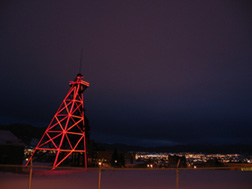
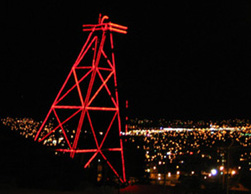
On July 1, 2005, the Original (left) was illuminated in a brief ceremony marking the contribution of the Butte Soroptimists’ Club. The Butte Soroptimists’ Club donated most of the funds needed to light the Original headframe in the same neighborhood where several of its members grew up. Their donation was supplemented by contributions from individuals and from money accumulated by setting aside 10 cents for every cellphone handset sold over several months by Copper City Wireless.
Then, the twin of the Original across Main Street, the Steward, was completed in September 2005 thanks to the Town Pump Charitable Foundation and their contribution toward that project. A lighting ceremony on October 12th, 2005 brought together about 150 people to commemorate the event, including about 50 retired workers who had worked below ground at the Steward and at the nearby Mountain Con just to the north in Centerville.
In December 2005, MERDI illuminated the Belmont headframe on the east side of the Butte Hill close to the Berkeley Pit. A month later at the Belmont Senior Citizen’s Center in what was once the hoist house for the Belmont, the new lighting configuration was dedicated by a lighting ceremony on January 31, 2006.
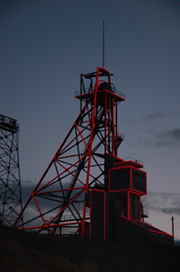
In the spring of 2006, Floyd and Margaret Bossard and their family stepped forward to pay for the lighting of the Mountain Con with the help of co-sponsors Bob and Pauline Poore, long-time community benefactors. Bossard is a retired mining HVAC engineer who learned his trade in the Mountain Con.
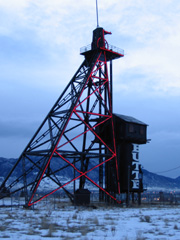
The mine actually descended to a depth of one mile, giving birth to the phrase about Butte “Mile High, Mile Deep” which has been painted on the front of the structure at the request of the Bossards. That headframe was illuminated in a brief ceremony on April 15, 2006.
In September 2007, the Bell Diamond was illuminated. A generous contribution by Northwestern Energy extended electrical lines to the headframe where there was no power available before. Butte-Silver Bow County built a road to allow equipment to more readily reach the site. Thanks to the major sponsorship of the O’Keefe Family, Mainstreet Uptown Butte ordered lights and they were installed by county workers Larry Morales and Sean Coates.
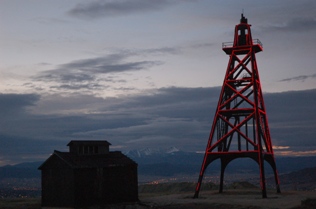
The Bell Diamond headframe is lit in honor of Butte pioneers, the Hickey brothers, who are ancestors of the sponsors, the O’Keefe family, and who, among many other things named the Anaconda mine before selling it to Marcus Daly and located and filed the Diamond claim.
The Bell-Diamond brings to eight of the Hill’s most visible headframes that have been received lights.
Most recently, in the fall of 2009, Mainstreet Uptown Butte collaborated in a project led by Butte-Silver Bow County to refurbish the lights on headframes on County property. Sections of lights were repaired and dark sections were replaced with lights provided by Mainstreet. Then, in a culmination of this project to upgrade the nighttime landscape, a new sponsor stepped forward to relight the Orphan Girl which had gone dark for almost a year. Lights were replaced and just before the holidays and the Orphan Girl headframe was lit at night once again, now in honor of the Robins Family thanks to sons Bert and Mike in loving memory of their mother. A dedication ceremony for the reilluminated Orphan Girl took place in July 2010.
Throughout this project, Mainstreet Uptown Butte has focused on keeping the effort moving forward by encouraging tax-deductible contributions to pay for the work to install the lights and looking ahead to ensure that the lights continue to be lit for years to come. Since the headframes are owned by different private and public entities, Mainstreet has worked with each to contact property owners and request permission to install lights on the structures. Several are owned by Butte-Silver Bow county. The Belmont is owned by MSE/MERDI and the Orphan Girl is owned by the World Museum of Mining.
After receiving permission, the next step has been to measure the structure. Research uncovered that there are no existing measurements of the cross members and other features of the structures on file anywhere so they have required careful measurements to determine how many lights are needed to light each.
Engineering students from Montana Tech provided detailed measurements for the Belmont and the Travona.
In 2004, the project received a major donation from Pioneer Technical Services in Butte. They provided the time and expertise to measure all of the remaining lighting candidates. Using state-of-the-art equipment that allows measurement from a distance, Pioneer Technical Services surveyors were able to measure the Orphan Girl, Original, Mountain Con, and Anselmo headframes.
The condition of electrical service to each headframe is also an important consideration for the project. Some have excellent electrical service, while others have required an upgrade and a couple have had no service at all. The county-owned headframes have received attention to upgrading their electrical service. Northwestern Energy made a generous and substantial contribution when they extended power lines to the Bell Diamond in 2007 to allow electricity to reach the lights on that headframe.
After measuring the linear feet to be covered with lights and assessing the suitability of electrical service to the site, the next step has been to order and install the lights. The lights specified for the project are low-energy, low-maintenance light-emitting diode (LED) light strings that are available for about $2 per foot.
Finally, efforts will begin before all of the headframes are lit to defray the costs of replacement lights, maintenance, and electrical costs in the coming years. Ultimately, the property owners will be responsible for future energy bills and it will be up to the community to help defray these costs in return for permission to install the lights.
The goal is to spread the costs broadly through participation from a coalition of volunteers, property owners, and citizens. Funding sources outside the community continue to be sought to help defray the costs of maintaining the lights and defraying the electrical costs of lighting the headframes in future years.
Most recently Mainstreet Uptown Butte has coordinated an effort to raise funds to purchase flags and replacement lights for five to seven headframes on the Hill.
To help lighten up Butte’s headframes and help defray the costs of maintenance and electricity costs to keep them lit, send a tax-deductible contribution to Mainstreet Uptown Butte, P.O. Box 696, Butte, MT 59703; or call 406-565-224964 for more information.